
Five years ago, I wrote about how Krav Maga transformed my mental health journey. For those who are unfamiliar, Krav Maga is the official self defense system of the Israeli Defense Forces and US Law Enforcement Agencies. Krav is a combination of boxing, kickboxing, MMA, Brazilian jiu-jitsu, karate, and various other forms of martial arts.
In my original post, I discussed how I fell into a deep depressive episode over the course of 2017 and through therapy, medication, the support of loved ones, and Krav, I pushed through. Krav taught me what I refer to as “aggressive meditation,” a way of clearing your head without sitting cross-legged, taking deep breaths, and trying really hard not to think about anything (not that I have anything against it, but stopping the racing thoughts has always been harder for me when I’m sitting still). Advancing through the belt program rebuilt confidence I thought I’d lost. I knew I wasn’t out of the woods entirely, but I ended my piece with hope and a sense of finality: a chapter closed.
Four months after the post was published, my older brother Tom died by suicide. A year after the post was published, my grandfather passed away from leukemia, and a few months after that, my great aunt passed from dementia.
In the weeks and months following Tom’s passing, Krav was still a constant for me. My coaches and classmates supported and comforted me when it was clear it had taken all of me just to be there. Even in the intensity of class, in defending myself from attacks or sparring with my partner, it became difficult to clear my head. Perhaps the supporting structure of my “aggressive meditation” had weakened when my entire reality shifted. Losing my brother so early in life was something so unexpected. We train to expect the unexpected, but this was beyond my purview.
One evening, my training partner must have noticed my detachment and approached me after class. I told her about my brother.
“What’s your brother’s name?” she asked. “What was he like? What did he like to do?”
“Tom. He wanted to make movies. He wrote film scripts,” I said. “He had a dark sense of humor, but he also very kind.”
We talked a bit more, and got more into talking about writing. As it turned out, she actually studied English in college as I had, and wrote poetry. I told her to send me some of her poems sometime. We packed up our gear and before she left, she said:
“Thank you for sharing Tom with me today.”
It only required asking a few simple questions to turn my night around, to allow me to gift someone with my memories of Tom. I realized that my reality outside class didn’t have to fully disappear during training; in fact, I can’t just run away from my grief and sadness by training. I had to give myself the time to feel everything I was feeling in order to bring myself back to the moment and focus solely on learning my techniques.
So, where does Krav stand in my mental health journey now? It’s a little complicated. Last September, I failed my purple belt midterm, which came as a complete shock to me. I’d never failed a midterm test (typically a class-length assessment of the techniques learned over the last three to six months). A few weeks later, after practicing the defenses I’d screwed up, I asked to be tested again. I failed, again.
Something about this failure in combination with my uncertainty in my career sent me in a downward spiral in a way Krav has never affected me before. I was feeling hopeless all the time, physically heavy, I knew I’d been here before. This time I knew what to do. I confided in my therapist, called my psychiatrist about changing my medication, and I kept going to Krav. I wasn’t going to get better by pouting and staying home.
A month or so later, my coach asked me once more to demo the techniques I’d previously messed up. I finally passed my midterm, and coach put my midterm stripe on my belt. Never was a little piece of tape so validating for me.
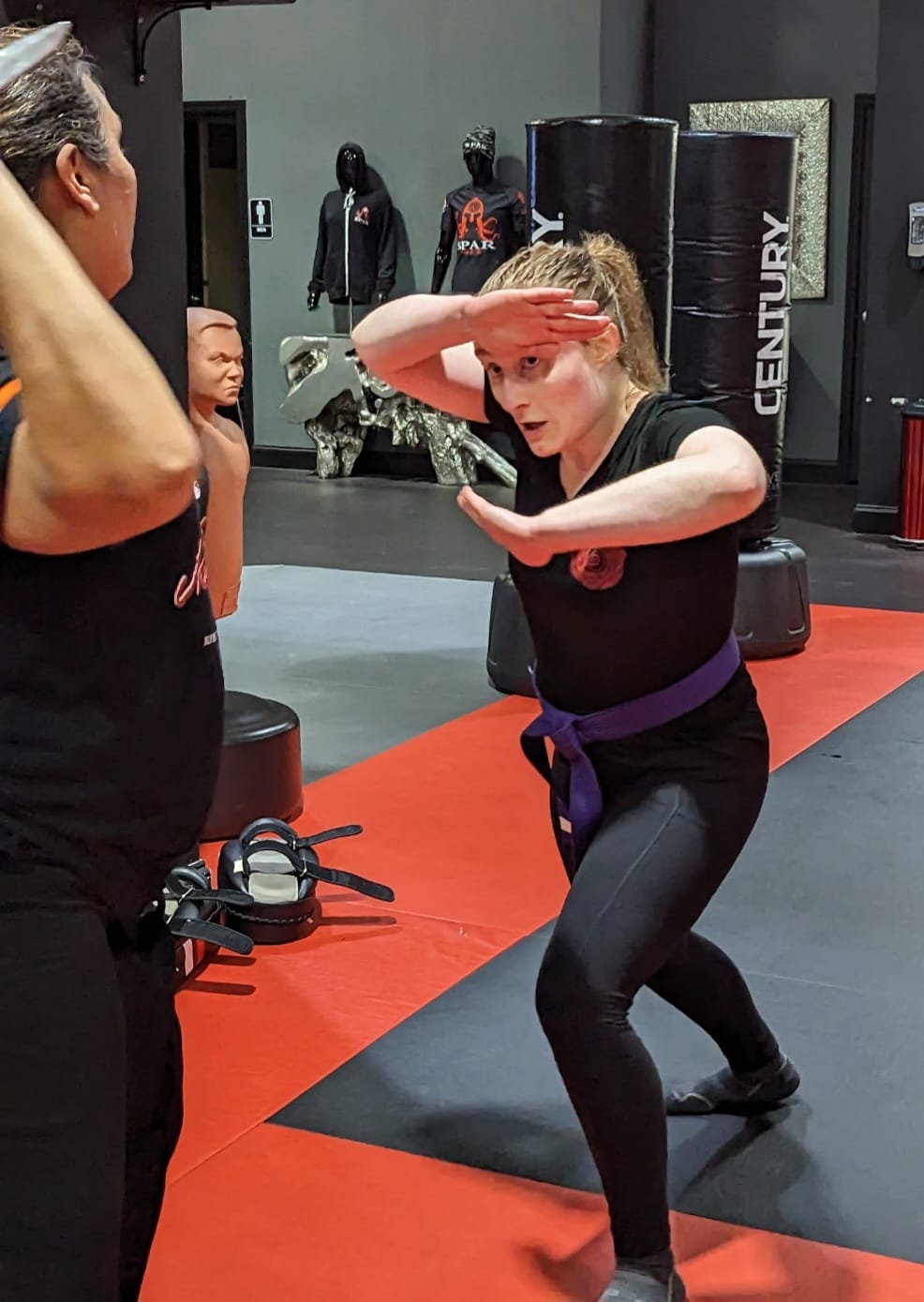
Photo credit: Spar Self Defense.
A few months after that, I tested for my brown belt. During the warm up, I genuinely thought I wasn’t going to make it. My legs wobbled, my head felt light, but my classmates wouldn’t let me give up. The test challenged my ability to improvise in scenarios when my learned defenses didn’t go as planned. After two hours, physically depleted beyond my limits, I got my brown belt.
I’ve heard there’s something uniquely Western about belts measuring our progress, that we need them to feel accomplished. I think that’s true for me, at least. By celebrating the smaller achievements along the way, you give yourself another boost to move forward. My mental health and Krav journeys can both feel like I’m taking a step forward only to take a couple steps back, but progress is rarely linear. I’m still fighting, but I understand more now than I did before that I’m not alone. That’s all I have to share for now.
Sign up here to be notified of my weekly posts, offers, and promotions.
Featured Photo Credit: Julia Larson
 Hanna Etu
One thought on “Progress Is Rarely Linear: A Follow-Up on Krav and My Mental Health”