Fighting Back: What Krav Maga Changed about My Recovery from Depression

Originally published on MadintheAttic.org in August 20, 2018. Last updated October 8, 2022.

When you sign up for Krav Maga—or any form of martial arts, for that matter—you have to be ready to get hit in the face. If you’re anything like me, this will happen far more often than your pride or your migraine condition would like to allow. In training exercises, when everything is done at a slower pace, you may dodge or counter nearly every carefully placed punch by your patient partner. But when you spar a real opponent, you’re never going to truly learn how to fight back until you become tired of getting hit one too many times.

This is true of Krav as it is true of life. For me, this moment happened in early 2017, when a major depressive episode hit me like a blow to the gut. Hardships in my personal life, including challenges in my family and an unexpected breakup, sent years of underlying depression and anxiety devastating my entire body, leaving me limp, unmotivated, and paralyzed by a future I hadn’t prepared for. Sure, I was twenty-three, with a great job, a beautiful apartment, and family and friends who loved me; I’m white, straight, cisgender. “You have your whole life ahead of you,” everyone kept telling me. “Sure,” I kept wanting to say. “Tell that to my depression.”

Further building the illusion that my life was fantastic in the eyes of the “oh, you’re still depressed?” kinds of critics, I was an extremely high-functioning depressive. Outwardly, my life didn’t seem to change from what had been, until that point, my normal. I never stopped functioning, living my life as I had done every day before. Now it just had this “oh, fuck” factor. By this I mean that I pushed myself to keep doing all of my daily tasks. I would go to work depressed (cry silently at my desk), sleep depressed (wake up feeling raw), shower depressed (feel like my whole body was sinking to the floor), drive depressed (cry in the car to and from work), and socialize depressed (apologize after bursting into tears following a perfectly nice outing with perfectly nice people). But working out depressed? I soon discovered that this was something else entirely. It wasn’t debilitating. It was liberating.

For about a year prior to my major depressive episode, I’d been training in a beginner’s level, all women’s self-defense class. I originally chose to do this to build my self-confidence, to make me feel more comfortable living alone, and also because I’d been a victim of stalking in a previous workplace. After realizing my episode, I spent a few more months in the women’s class before deciding to sign up for additional fitness classes such as kickboxing, boxing, and warrior class (essentially a boot camp–type class that pushes your body to its absolute limits but has great results over time). I quickly tapped into a resource I couldn’t find anywhere else. The strength training, conditioning, and practice allowed me to concentrate on a part of me I’d never (as a nonathletic, certified nerd and English major) considered much before. By punching a cage bag (a heavy punching bag used for boxing) with all of the power left in my body, I became closer with my physical self—I felt a separation from the chaos in my mind, or, as I like to call it, I began practicing an aggressive meditation.

I easily prefer this over traditional meditation, which always feels like an invitation for dwelling on obsessive thoughts. I spend the entire time thinking about what I need to do later, how I could have said something differently that day, or how anxious I am for something going on the next day. Aggressive meditation has allowed me to leave the rest of my day at the door, clearing my head as long as I’m moving, punching, and challenging my body to see how far I can go and how much stronger I can be. It’s heartening when I leave class and realize I just spent thirty minutes, an hour, or even two hours not thinking about what was hurting me emotionally that day. Nothing else, other than a dreamless sleep, could fully do that on my worst days.

Not long after starting new fitness classes, I decided, after much encouragement from coaches and fellow classmates, to advance to the Krav Maga belt program to further develop my self-defense training. If you’re unfamiliar, Krav Maga is the official self-defense system of the Israeli Defense Forces (originally developed for the IDF) and US law enforcement agencies. The fighting style combines aspects of boxing, kickboxing, MMA, Brazilian jiu-jitsu, karate, and various other forms of martial arts. It is a no nonsense, pure survival kind of defense intended to be accessible for all people of all ages and body types.

Personally, I think that learning how to defend yourself from the most violent, brutal attacks is one of the best groin kicks to the patriarchy there is. It returns to you ownership of your body—a sense of ownership that as a woman, as a person with mental-health issues, or as both, you often can lose. Depression and anxiety loosen feelings of self-doubt, insecurity, shame, and embarrassment for the person you think you are. Depression can separate you from who you truly believe you are, making you feel lethargic and unable to carry out your usual tasks. It takes away your power to choose, your power to know what you want and carry that out. Further, as a woman you are constantly threatened into feeling like you don’t quite own your own body, like you need to get out of the way, take up less space, but also like you’re up for examination at any time. Someone can come up to you and ask, “have you lost weight?” as if your rating in some imaginary system just went up. Or you can get the dreaded body scan accompanied by a disgusted expression, as if the person shamelessly staring at you has just smelled something terrible and they are offended by your mere physical presence. Men feel free to shout at you on the street and comment on your body as if it’s a product brought out for their review.

It’s refreshing and perhaps cleansing to connect with your physical self, particularly when you’re going through a dark time. When I’m in Krav, I’m not thinking about anything but the technique, the strikes, and working on all of the little details that make a big difference in keeping myself unharmed while doing the maximum amount of damage to my attacker. There’s no time for daydreaming in drills when you’re pounding strikes on the pad, maybe getting pushed around on different sides to keep you grounded and focused, and getting safely, spontaneously drilled on defenses by other classmates. All you can do is focus on the sequence of moves and strikes, getting control of your attacker, and getting out of the situation.

In my past, I have been stalked, sexually coerced, emotionally abused, and sexually harassed. My training in Krav Maga physically manifests this truth: nobody will touch me without my consent, nobody will hurt me, nobody will rape me, and nobody will make me feel unsafe in my workplace or anywhere else. Knowing how to defend myself gives me that power back. It gives me my body back. Krav does all of this for me by strengthening my body and mind to perform in high-pressure situations which no longer baffle me, despite my chronic anxiety and depression-induced insecurities. Now, I can’t go so far as to say that it cures my depression; for me, my treatment is a combined effort of therapy, Krav Maga, medication, a healthy sleep schedule, and support from my family, boyfriend, friends, and coworkers. No one tool is in itself a panacea, but each component is vital to my well-being and success as a person. Krav Maga has aided my recovery and continues to supplement my well-being on a level I can’t find anywhere else. The confidence I have built on the mat is unparalleled to anything I’ve experienced before, and the community brings pure, unprejudiced support that doesn’t judge me for who I was before I walked in the door.

This is what has worked for me. I’d like to be clear that I have no intention of suggesting that Krav or any other form of exercise is a replacement for medication, nor, alternatively, do I wish to impose any kind of pro-medication agenda. I use exercise to supplement my psychiatric treatment that I sought out by my own free will. I find it works well for my happiness and well-being. I do not support coercive psychiatric treatment, and I also do not support anti-medication “propaganda” (if you will), such as memes that suggest a run in the woods is a “real” antidepressant. I think those types of messages are toxic and hurtful to those who actively need to treat themselves with medication in order to feel healthy and whole every day. I believe that the right path to better mental health is always each individual’s choice, it is their human right, to choose what happens to their body now and in the future. Again, this is what works for me—these are the tools that help me be my best self. What works for you can and will be different.

When it comes to recovering from mental-health issues, everybody says that “one day, the sun comes out,” but it’s never like that. And nobody who is a responsible adult believes someone or something is going to make everything better; this happens over time, with sacrifice, adaptation, hard work, and help; whatever “help” means to you, if you choose to seek it, and if it is of any value to you. My depression did not immediately improve after starting the belt program, in fact, it endured for almost the rest of the year until I progressed into what I guess you could call a “remission.” Again, though, it didn’t start with one great, perfect day. Remission, in this respect, is cumulative.

I sought medical assistance from my general practitioner on a desperate day in March 2017, who prescribed me an antidepressant. This began to take effect in a few months and seemed to be helping for a little while. But recovery comes with a lot of a false starts. I could highlight the good months and bad months on my calendar; improvement was not at all linear. Eventually I didn’t feel like I was getting where I needed to be. I was still having frequent anxiety, and my medication at the time only treated depression. In May 2017, I called to make an appointment with a psychiatrist whom my therapist had recommended and the office was booked until August. A month before my appointment, the office contacted me to cancel the appointment. I contacted the office to reschedule, only to be put off another month, into September. This appointment was canceled a month later. By September, after having waited since May for an appointment—and even though I had made progress on my own through exercise, counseling, and family support—I still was on the floor, in tears, wanting to know why the system hated me. Looking back, I wonder, what if I had been suicidal (I wasn’t at that point) and they had just tossed me aside? The office manager had zero sympathy for my case, which I pleaded vehemently. I ended up seeking out another psychiatrist, who kept her appointments and has been lovely—and not coercive—when it comes to trying new medications or increasing my doses. But this, I know, is rare.

Needless to say, since meeting my psychiatrist, my outlook and self-awareness have turned around. My anxiety has been less frequent and my depression no longer feels like a full-time or even a part-time job. I know it’s there, but it’s under control, and I’m optimistic. For most of my adolescent life, I was extremely opposed to psychiatric medication after watching the impacts it would have on friends and family members. Before trying the medication route, I went to a naturopathic doctor, who essentially told me to give up eating everything I love and take supplements I couldn’t afford. This, long story short, only made me more miserable. Medication was not the one key thing that “saved” me, but it did turn out to be a missing piece in my quest to bring myself back to life. Krav, family, friends, work, sleep, and medication are all important components to my happiness; medication just turned out to be one I hadn’t yet figured out.

Presented this way, in black and white, it could appear as if my road to remission and eventual recovery is neat and tidy—as if I have all of the answers and now live a life free from any mental or emotional struggles. This is not the case. Through trial and error, I eventually collected the tools and strategies I need to get through my mental and emotional challenges every day, and that is working for me. That said, I know it’s not so simple for everyone struggling with some form of mental illness. I am a white, straight, cisgender woman who is, as of the time of this writing, still on my parents’ health insurance (though I pay all of my own medical expenses). My counselor is a woman and my psychiatrist is a woman; these facts definitely play a role in with how seriously I am taken when discussing my mental health. I don’t think everyone should seek help in all of the same ways that I have, because we all have different challenge and conditions, and we all have different privileges (or lack thereof). There is always someone who has it worse than you do, but that basic fact never means that your struggles less important or less real. I am infinitely grateful for all of the help that has been provided to me and all of the love and support that has surrounded me for the last year and a half. But my progress doesn’t belong to the mental-health system, or Prozac—it belongs to me. It is something I earned, both on and off the mat. Krav is one of the most important aspects of my life now. It has helped me seek my own validation, rather than from those around me, and also how to fight back, not just physically, but mentally. I am stronger for what I have been through, and I have the tools to face personal setbacks, should they happen again. And if they do, next time, I’ll have my fists raised, ready to strike.

Featured photo credited to Michael Etu.

For Our Daughters 2016 Gala Will Inspire and Heal

Originally published on StreetPoetz.com on March 8, 2016. Last edited and updated October 8, 2022.

The fifth annual For Our Daughters Fundraising Gala will take place on Saturday, October 22nd, a night for honoring courageous survivors of breast cancer, enjoying great music, and contributing to a worthy cause. With ticket sales beginning on March 4th, and women’s health an important topic of concern, it couldn’t be a more vital time to get involved in the fight against breast cancer and the charge for better health education for young women.

Back in the fall, we told you about the For Our Daughters 2015 gala, where Mercedes Wilson and poet Lazyrus enchanted the audience, with Wilson singing Alicia Keys’s “Superwoman,” paired with an original piece written and performed by Lazyrus which they dedicated to the breast cancer survivors. The song was demonstrative of her courage and fight against a condition she did not allow to rule her life. As a breast cancer survivor, she touched the hearts of all the other survivors in the room, honoring their struggles, challenges, and triumphs. That night, she inspired her audience with her performance, and even more importantly, through the selfless work she has done over the last four years to continue to educate young women about their health and wellness.

After being diagnosed with breast cancer at twenty-eight, Wilson realized how much her diagnosis had caught her off-guard—she didn’t expect to have to think about cancer at such a young age. She thought about all of the other young women who could also be caught blindsided, if they weren’t better educated about their health. Hardly a year after her diagnosis, For Our Daughters Inc. was born. Wilson’s organization has grown to travel to schools all over Western New York, helping young women better understand their health risks and what they can do to better take care of themselves.

This fall, Wilson will be hosting the fifth annual For Our Daughters Gala to raise money to allow the organization to visit more schools in the Western New York region. This year’s event will host 2013 American Idol winner Candice Glover. Known for her admirable perseverance; Glover tried out for American Idol three times before making it to the live rounds. A singer famous for soulful, empowering music, Glover will perform songs dedicated to all of the breast cancer survivors in attendance that night. She will continue the legacy of both honoring the survivors in the room and inspiring them. Glover will also stay for a meet and greet with the guests afterwards, between 10 and 11p.m.  In addition, there will also be live music from the local Niagara Falls band DBelly Productions as well as a three-course meal, open bar, live cake auctions, silent auctions, and much more. There are plenty of opportunities to support the cause, no matter how you choose to contribute.

FOD-Gala-Web-Flyer

The event is always a classy way to spend an evening, and make you feel satisfied that you’ve helped more young women take control of their lives. When asked what she thought of last year’s gala one guest and breast cancer survivor Kathleen Kowal said, “It was magical. I was overwhelmed with the detail and the beauty of the room.”

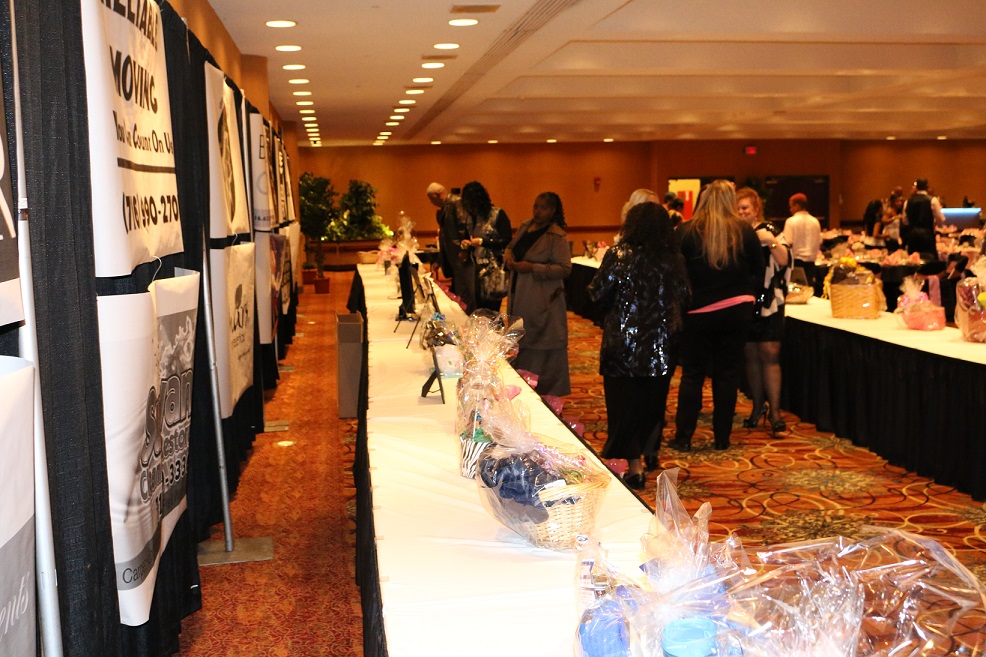
Surviving breast cancer is not exactly an accomplishment rewarded with a medal, it is instead awarded with the prize of life, and getting time back with loved ones. This night is an acknowledgment of all that the survivors have overcome and also a night of healing. Survivors may be medically healed, but this night—listening to the music specifically dedicated to their journeys, their pains, and their joys—heals the soul. The impact of the music at last year’s gala was healing to all in attendance, not just the survivors. It shows us that the art of music is not only a means of expression, or of telling a story, but it is also a way of using our stories to connect with other people and heal the frustrations in their hearts.  The gala allows breast cancer survivors, friends, and generous sponsors alike to get together and look towards the future.

The event will take place from 6–10pm on October 22nd at the Buffalo Niagara Convention center, and the meet and greet with Candice Glover will take place afterward, from 10–11pm.

Tickets are $60 for adults, and $30 for children.

(Click here to learn about the 2018 Gala and the upcoming 2019 Gala.)

Featured image credited to Dan Hallman / Invision / AP.

*Please note that StreetPoetz is no longer an active site and the founder, Cece Carson, is now a business coach. Please contact her if a reference is needed.*

A True Superwoman Performs a Song of Survival

Originally published on StreetPoetz.com on November 11, 2015. Last edited October 8, 2022.

Mercedes Wilson’s voice captivated the attendees of the fourth annual For Our Daughters Gala on Friday, October 30th. While her heartfelt singing and commanding voice were beautiful and exhibited incredible talent, it was also the words of the song, “Superwoman” by Alicia Keys, and the accompanying spoken word poem written and performed by Thomas “Lazyrus” Panzarella that reached every soul in the room.

Mercedes Wilson is a breast cancer survivor. “I was diagnosed with stage 2 breast cancer at the age of 28.” Wilson says. “This flipped my world upside down. No one ever wants to hear those words, especially at such a young age!”

The shock of such news is unimaginable to anyone who’s never experienced it. To most people, hearing those words would feel like facing death. But for Mercedes Wilson, her diagnosis was an eye opener and a call to action:

“It was during that process that I learned how much I actually didn’t know! I had to learn my family history and get lessons on healthy living.”

Mercedes2
Photo Credit: Will Jones from BWNY magazine.

Wilson realized, at twenty-eight, when most people believe they have a whole life ahead of them, how much she did not know about her own health. There are many factors that can influence someone’s risk of breast cancer, even in young people; and most young people, particularly young women, are not aware of them. Wilson decided this needed to change. In June of 2012, barely a year after she was diagnosed, Wilson founded her own non-profit organization, For Our Daughters Inc. Wilson says:

“That’s where the mission to ‘empower young women to break down communication barriers and become advocates for their own health and wellness’ came from. Through For Our Daughters, my goal is to educate young women on how to open up dialogue with mothers everywhere and learn their risks and find their voices when it comes to their health and wellness.”

This kind of information could make the difference of life or death for someone, so it is crucial that this information is accessible to young women and young people in general. For Our Daughters Inc. travels to middle and high schools in the Western New York Area, educating young women about better health and wellness practices and cancer prevention, consequently inspiring young women to be their own voices for their health.

Two of the many moving voices at the night of the For Our Daughters Gala—which was held to raise funds that would enable the organization to continue traveling to different schools in Western New York—were that of Mercedes Wilson and her accompanying spoken word poet, Lazyrus. “Superwoman” is a song about female empowerment, a song of survival. Wilson’s performance breathtakingly reached out to every breast cancer survivor. About choosing the song, Wilson says:

“I was sitting and thinking about how to pay tribute to breast cancer survivors at the gala and a friend suggested that I sing. I was very hesitant, but agreed to it. I asked another friend to come up with a list of inspirational songs. She gave me a list of songs and ‘Superwoman’ popped out to me. It speaks of struggle and triumph. It gives credit where credit is due for so many struggling women!”

“Superwoman” talks about the battles we as women face alone, and the masks we wear to show everyone that we are okay, we’re still strong, even if we don’t feel the same way on the inside: “Even when I’m a mess / I still put on a vest / With an S on my chest” (Lyrics from azlyrics.com). Wilson sings straight from the heart, as if she is speaking to us directly about her experience fighting breast cancer; her pain, her struggle, and her eventually, powerfully, coming out on top. Wilson wants every survivor to know that they are a superwoman too, that they have overcome one of the most difficult and painful challenges imaginable, and they are stronger for it:

“The song makes me feel empowered as a survivor and also grateful to know that it made so many other women feel the same way. It was truly an honor to see so many women inspired! Music is an art that can do so many things! It has the power to take you back to the past, give you hope for the future, heal relationships, cure a broken heart, make changes in your life, recognize some things you didn’t know were there in the first place. Music got me through so many lonely nights, it helped me to not lose my mind while going through cancer, allowed me to express my fears, frustrations, triumphs, and make it through cancer.”

Gala-2
Photo Credit: Will Jones from BWNY magazine.

Wilson certainly showed how powerful music is in influencing other people and inciting our emotions. This collective experience was even more enhanced with the addition of Lazyrus’s spoken word poem at the end of the song.  Lazyrus is very personal and touching in his words, talking about the shock of getting a diagnosis, and all of the questions young women have when this happens, the feeling of the unknown. Young women, even in their twenties, still think of themselves as “just a girl,” as Lazyrus says, but he points out how their overcoming of the pain, the radiation, the uncertainty, is what makes them much more than “just a girl.” Lazyrus talks about knowing Mercedes Wilson during her battle with cancer, remembering the days he knew she was really suffering, but she kept her head held strong. Young women like Wilson are required by their fight with cancer to age quicker, mature faster, until they are no longer “just a girl.” They become an unstoppable force against cancer, against death: a Superwoman.

On deciding to pair the song with spoken word poetry, Wilson says:

“The idea of the poet just came to me. I really wanted something that spoke to the women in the room. I gave Thomas the song that I was singing and told him what the night was about and he did the rest! We actually only had one rehearsal and it just came together.”

Wilson asked Lazyrus to write the poem after he was recommended to her by Streetpoetz. She told him the purpose of the event, the context of the song, and he wrote the poem from there. On writing and performing the poem, Lazyrus says:

“The poem itself, literally, just came to me in about a half an hour. That was the easy part. I’ve performed many times but felt a little nervous about this one. I felt an obligation to these women to make sure it came out good. They deserved something special, I thought.”

Lazyrus
Photo Credit: James Wilson.

Wilson’s collaboration with Lazyrus shows how powerful art can truly be. The art Wilson and Lazyrus have created together is not only an expression of great talent and artistic ability; it is a message that has brought people together and inspired them to influence change. Hearing the beautiful singing of Wilson and the lasting words of Lazyrus have brought community to breast cancer survivors and their loved ones and reminded people of the bravery every survivor has demonstrated. Their performance reminds us of the importance of art, that art touches us in a way nothing else can—it reaches our hearts, reminds us to be grateful for our own lives, and motivates us to take advantage of the time that has been given to us.

Gala-1.1
Photo Credit: Will Jones from BWNY Magazine.

How can we do this? By educating young people about the risks of breast cancer and what it means to understand your own health and be your own advocate, and by supporting organizations such as Wilson’s. Wilson is optimistic about the future of For Our Daughters Inc., and the future of women speaking up for themselves when it comes to better health and wellness:

“I see For Our Daughters inspiring young women all over the world, empowering them to find their voices and using that to help someone else! Long healthy lives are what we are after, and having a closed mouth prevents that. Our voices matter.”

For more information on how you can get involved, check out ForOurDaughtersInc.org or click here to donate so that more young women can be better informed about their health.

To see Mercedes’s performance, check out the YouTube video here taken and arranged by Ray Almonte of Blackfire Recordings.

Feature photo taken by Will Jones from BWNY Magazine.

*Please note that StreetPoetz is no longer an active site and the founder, Cece Carson, is now a business coach. Please contact her if a reference is needed.*

CoderDojo Encourages Young Creative Talent

Originally published on StreetPoetz.com on January 26, 2016. Last updated October 8, 2022.

Creativity can take many forms. When we think of art, we generally think about the paintings and sculptures we pass by in a gallery, or a musical or poetic performance we catch in a café or theater. Rarely do we think about the art of code and creating new facets of technology, like apps, webpages, or games. We don’t think about the creativity it takes find the little details that can make technology more effective and fun. We don’t usually think about the art of caring, of educating, of using our talents, knowledge, and creativity to better the lives of others. Michael Simmons is expressing this art through his recent founding of a new chapter of CoderDojo in Southern Connecticut.

“Our mission is to create a fun, collaborative environment to explore STEM (Science, Technology, Engineering and Mathematics).” Simmons says. “Through play, the youth can build memorable experiences with mentors to ignite passion for technology at an early age.”

CoderDojo as a global organization is, as its website suggests, a “global network of free computer programming clubs for young people.” CoderDojo is sponsored by the CoderDojo Foundation, which is based out of Dublin, Ireland, and aids programs around the world aimed at educating people from ages seven to seventeen on various areas of coding.

Michael Simmons decided to take this mission to the Southern Connecticut community.

“I became involved when I received an invite through a group on meetup.com (Coders for Good) to become a mentor for a non-profit organization called CoderDojo NYC,” Simmons says. “After receiving the invite I looked into what exactly was a CoderDojo. The idea of CoderDojo was very intriguing and it was amazing how many chapters were established around the world.  But there was one small problem. The closest dojo to Connecticut was 37 miles away. With this discovery, I saw the perfect opportunity to get involved by opening a chapter and give back to the community.”

The program is a great addition to a community, as the advanced concepts of coding and computer programming are not something normally taught in schools, at least not in such thorough detail. It also brings young people of similar interests together. Computer programming can often be a solo art, and CoderDojo harnesses this common interest to create friendships, not just enhance personal skills.

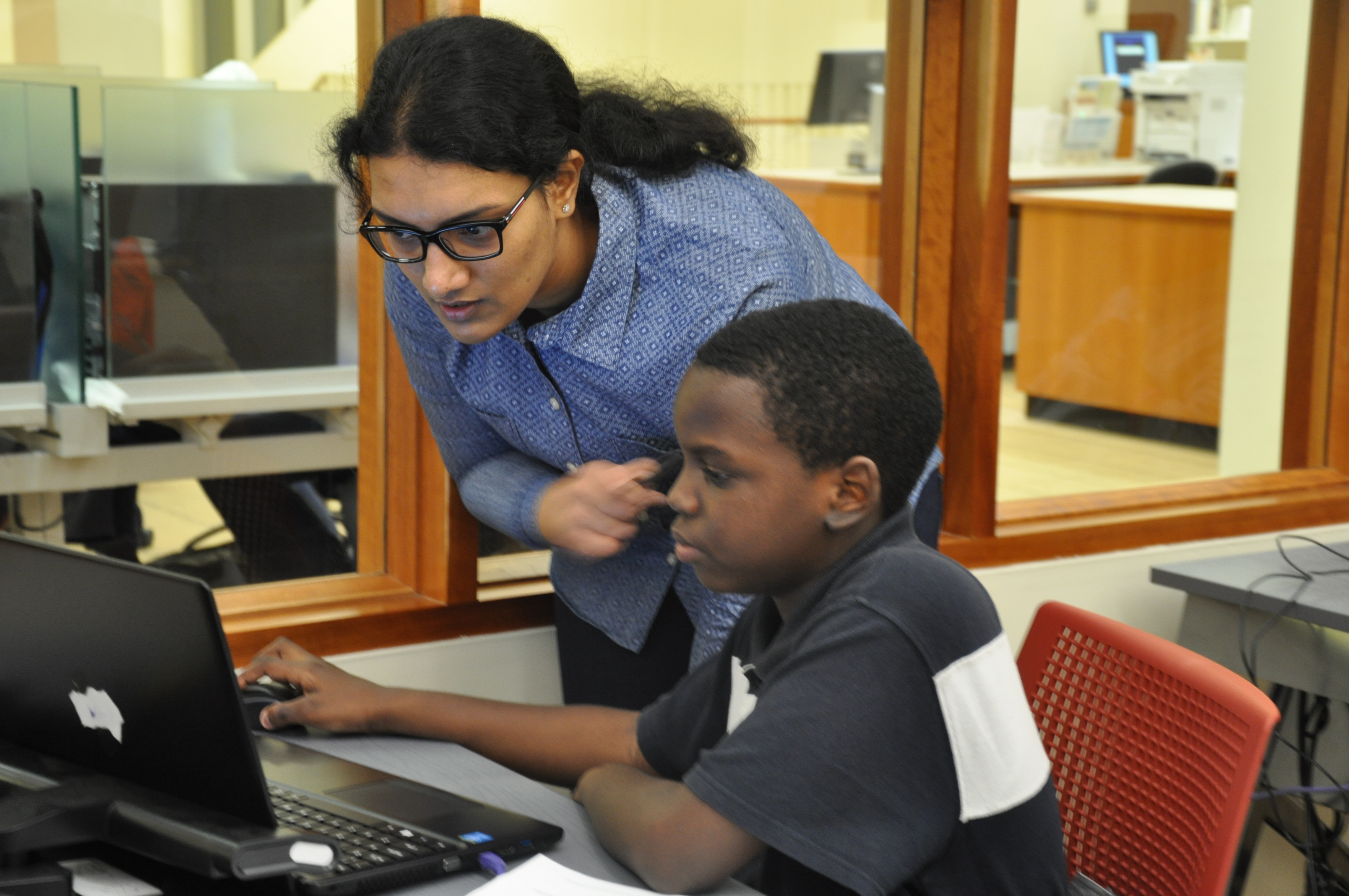
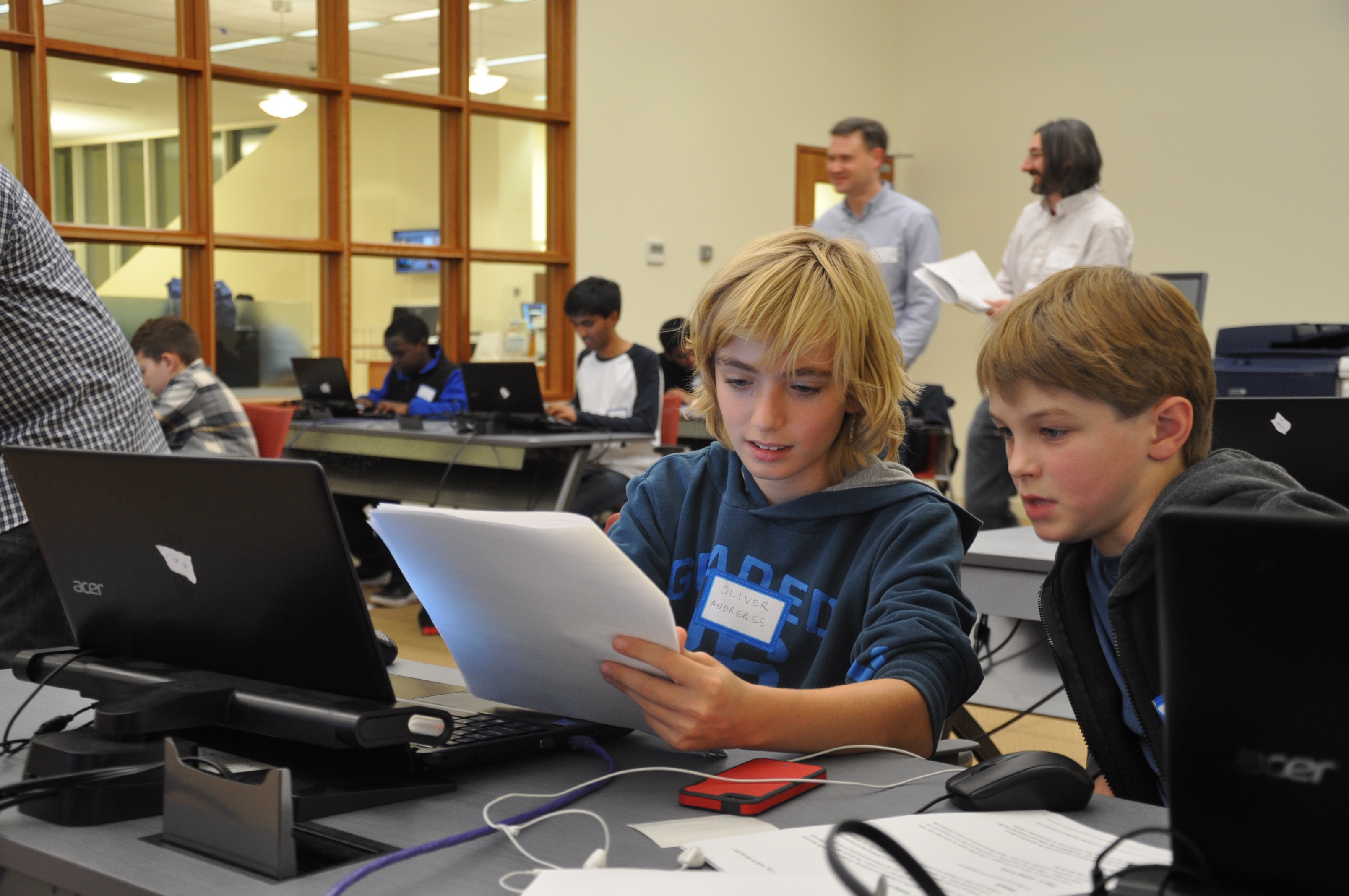
“We teach the youth, ages of 7–17, how to design, code and develop websites, apps, and games while exploring technology in an informal and creative environment,” Simmons says. “Within the Southern Connecticut Chapter there is a focus on community, peer learning, youth mentoring and self-led learning, as well as soft skills—like self-awareness and a positive work ethic.”

Students can participate in a variety of workshops that develop their coding skills, such as a workshop on creating their own html. “We have taught a class on, ‘How to Build a Web Page,’ using basic HTML5 and CSS,” Simmons says. “We are building on this workshop with a workshop on CSS3 and Javascript in January 2016. Also coming in early 2016 are workshops on graphic design using Photoshop, Illustrator and Blender (3D design program).”

DSC_0381
Photo taken by CoderDojo Southern Connecticut Staff.

Simmons has a strong background in computer programming.

“From getting my very first computer, the ‘Commodore 64’ in 1982, I always liked working with computers,” Simmons says. “But it wasn’t until 2002 when I researched how web pages were created. After I read my first book on web development, ‘HTML 4 for the World Wide Web: Visual Quickstart Guide by Elizabeth Castro’ and created a couple examples, I was hooked. This is when I found my love for coding. Being self-taught with over 12 years of experience, I’ve built websites for various Fortune 500 clients including but not limited to AARP, AIG, Bank of America, Cingular, Motorola and Washington Mutual.”

Simmons followed his love for coding into a career, which he continues today, making him a knowledgeable resource and mentor for students interested in coding.

“Currently, I am a Senior Applications Developer for Starwood Hotels & Resorts,” Simmons says. “While at Starwood, I’ve developed mobile and desktop sites for all of Starwood’s Brands and architected the framework for the redesign and modernization of Starwood’s desktop brand sites such as but not limited to Sheraton, Tribute Portfolio, Le Meridien and Design Hotels™.”

What makes the Southern Connecticut chapter of CoderDojo so special is that it is run entirely by volunteers, people who have chosen to commit their time to the education of young people without expecting anything in return. “Our volunteers come from corporations, organizations, colleges/universities and other communities within Fairfield County, Connecticut including but not limited to Starwood Hotels & Resorts, FactSet, The Business Council of Fairfield County and Norwalk Community College,” Simmons says. The students get the personalized attention of teachers who are genuinely excited about technology and helping other people. To have volunteers as teachers can also provide the important lesson that we should share our talents to better the lives of other people, even if they cannot repay us.

The experience of each student is truly meaningful, as they begin to build a small community of peers and learn about the possibilities of technology. “I think it means a lot to a young person to learn how to design and develop web pages, apps and games because it is a rich learning experience for them,” Simmons says. “They learn life and soft skills such as solving problems, designing projects, communicating ideas, working as a team, how to persevere in the face of challenges and positive work ethics. These skills are important for everyone, not just people who will grow up to become scientists, engineers, or computer scientists.”

The concepts Simmons talks about are certainly skills eventually acquired through traditional education, but are definitely not the focus of schools today. This makes programs like CoderDojo essential for many intelligent students, who may excel academically, but not socially. When the focus of school is simply the curriculum, these soft skills may be set aside for the purposes [of] getting through material. CoderDojo, as a student’s choice rather than an obligation, can take the time to give each student abilities such as problem solving, communication, and community building.

“CoderDojo Southern Connecticut builds community by developing positive relationships with the youth,” Simmons says. “As we encourage the youth to be engaged in community activities they develop the skills needed and become empowered to be an effective leader. When the youth realize they have the power to influence decisions at a community or school level they will rise amongst their peers and begin to show signs of leadership.”

While the Southern Connecticut CoderDojo is a fairly new chapter, Simmons has already seen first-hand the true rewards of participating in the program.

“After our kickoff workshop (How to create a web page using HTML5 and CSS) in November, a parent personally came to thank me for starting [the] Southern Connecticut chapter,” Simmons says. “She went on to tell me about how her boys could not stop talking about CoderDojo. She said, ‘the whole ride home they were talking about CoderDojo, coding and how they were going to become CIA agents.’”

Computers and technology are changing and adapting at a rate faster than ever before. It is extremely important in this day and age for young people to have better expertise in these fields, as more and more technology replaces old inventions. More careers are going digital, and it will be helpful to be prepared for that. The STEM subjects are both practical and ever-changing areas of study, which is why it is important that students have a better understanding of modern technology. Even if some students do not go into the coding field as they become adults, this knowledge will help them in nearly any career they choose in the future, as more and more fields use new technology to work more efficiently. Simmons talks about the importance of teaching the STEM subjects when he says:

“It is very important because we live in a technology-fueled world.  Coders, UX/UI Designers and Engineering Technologist are quickly becoming a prized, 21st-century skill. Plus, it encourages kids to become creators, not just consumers, of the technology they use.”

Becoming a creator, rather than a consumer, can be key to staying ahead in the technological world. A creator can develop the next app that could kick start their own future business. Once a young person becomes in touch with their creativity, their possibilities are endless for the future (even if they choose not to go into the STEM field). A young imagination has incredible potential, which can be utilized by continually stimulating it with learning new skills they may not have learned otherwise.

“It means a lot to me to be able to give back to the community by teaching kids how to code and getting them excited and inspired about technology,” Simmons says. “Mentors and colleagues have shared their knowledge about technology with me throughout my career.  Which has played a significant role with the evolution of my skills as a web developer.”

DSC_0336
Photo taken by CoderDojo Staff.

Simmons has begun a life-changing program for many intelligent and creative students, passing on his extensive knowledge of technology to young minds. The CoderDojo experience is educational but also communal, teaching students how to work well with others, build their self-esteem, and become part of a community.

When asked what we should expect from CoderDojo in the future, Simmons says:

“To continue the success we had getting kids excited and inspired about technology as we did with our very first workshop in November.  We are focused on developing fresh curriculums for future events and releasing our website http://www.coderdojosoconn.org in January 2016.”

You can now check out CoderDojo of Southern Connecticut at http://www.coderdojosoconn.org or on Facebook and Twitter for more information.

*Please note that StreetPoetz is no longer an active site and the founder, Cece Carson, is now a business coach. Please contact her if a reference is needed.*

Colors of Human Experience

Alex Fernandez’s Impressions of Life and Art

Originally published on StreetPoetz.com on September 7, 2015. Last edited October 8, 2022.

When I first met Alex Fernandez nearly nine years ago, I immediately discovered he had a talent for impressions. He could impersonate anyone he came across—friend, coworker, enemy, or otherwise—with shocking accuracy. While he could imitate any voice, he could also pick up on the subtleties of someone’s facial expressions, gestures, ticks, and any other odd little habits, and replicate them. His imitations were not only a way to pass the time, they were his form of expression, a craft to be mastered and also enjoyed, just like one would enjoy a work of art, such as a painting.

What I did not discover until much later into knowing Alex was that he is, in fact, a painter. “It’s kind of funny because I’ve never thought about this,” Fernandez says, “and it’s still surreal to think of myself as an artist, but I’ve always known that I wanted to paint. I’ve been painting since as long as I can remember: as a kid I used to watch my sister as paint for one of her undergrad classes and learn[ed] the fundamentals with her.”

Fernandez works mainly with watercolor, and sometimes with oils. “I think I’ve finally found my appreciation for watercolor, as I’ve become more skilled with them,” Fernandez says. “I use them because they’re so versatile and they take a lot of effort to get the color layering right. They also show mistakes, and you can tell a good artist when they know how to skillfully correct them or draw the eye away from them.”

Fernandez’s work echoes the style of the Impressionists and Post-Impressionists, slightly unfocused but still vivid in color and emotional effect. “One of my earliest influences was Van Gogh,” Fernandez says. “My parents had a print of ‘Starry Night’ hung up that I used to look at and ‘admire’ as any child could; I used to joke with my friend that the moon in the painting looked like a toilet flushing.”

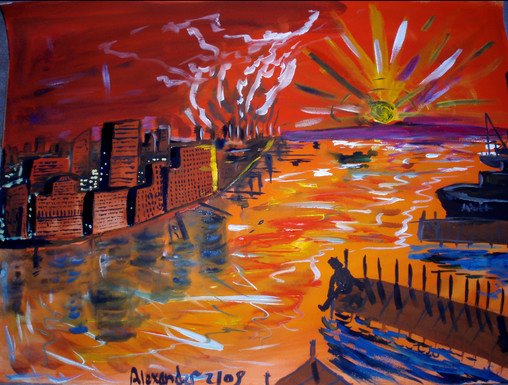
While his sense of humor may not always be reflected in his work, his imagination certainly is. Take this piece:

308133_130227593742324_1988830275_n
Untitled, Artist & Photo Credit: Alex Fernandez.

The river, predominately painted in shades of orange and red, more so than blue, could possibly evoke the feeling of an industrial city on fire. Using the fire image in a body of water creates a contradictory experience, a mixing of the elements. Is the city burning, or is it thriving?

“I have received a lot of compliments,” Fernandez says. “But the most interesting to me is when I was told I always have some aspect of fire in my work, and [I] jokingly stated it was because I had a house fire when I was a kid. But maybe there’s some kind of sub-conscious truth to it.”

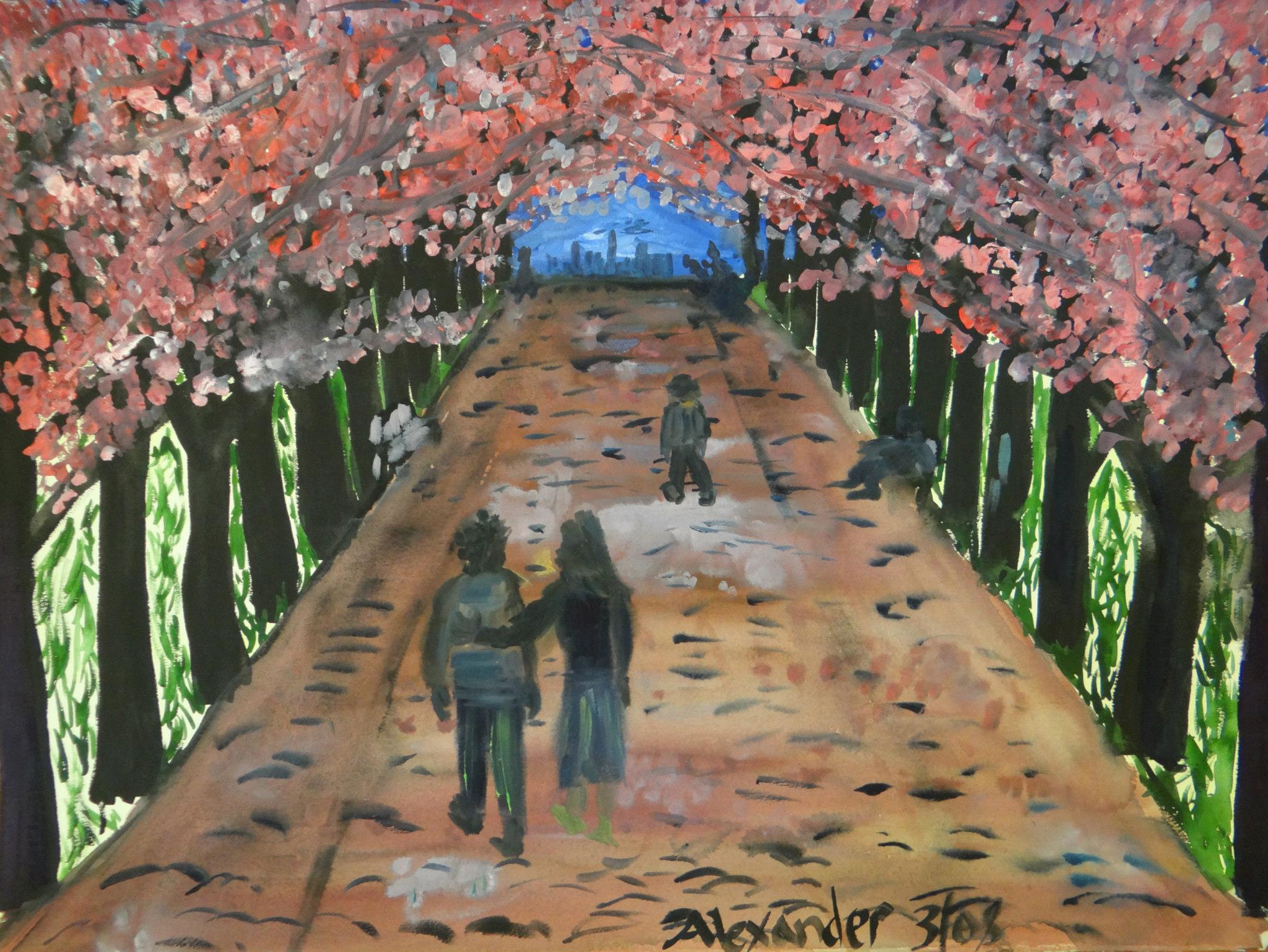
Color plays a large role in all of Fernandez’s paintings, inciting a particular mood beyond the realm of basic emotions. Take this painting:

774349_361175320647549_195407640_o
Untitled, Artist & Photo Credit: Alex Fernandez.

We are immediately drawn in by the vibrant flower archway that frames the piece. It seems to express happiness, contentment, and natural beauty. Then we see the people walking down the path, all painted in dark tones, giving us the impression that they are perhaps sad. But yet they walk together.

“I feel that all my work is either very bright or very dark,” Fernandez says. “I try to convey a sense of mystery usually; I want people to feel like the work could continue on beyond its borders. My biggest strength is with color, I use color often to convey some sort of emotional response, but as with anything, art is experienced by the individual.”

Recognizing the individual human experience is vital in understanding Fernandez’s work, as it is with all art. When asked about his influences, Fernandez says, “Nature is prevalent in my work, so I’ll say nature. But on a more grand scale I think every aspect of my life influences me. I can’t see how I couldn’t; we’re all influenced by what we experience.”

All art is an imitation of something, whether it is another artistic style or movement, an inspiring scene from nature, or just life experiences in general. Humans are complicated canvases of emotion. We are hardly ever just happy, or just sad; typically we use one expression of emotion to hide another, or feel multiple emotions at once, because life doesn’t just happen in an orderly fashion. Fernandez’s work achieves this complexity of emotion by competing light with dark, challenging these human experiences and feelings to work together.

Fernandez has high hopes for art in the future. “I wish that art will become more accessible to all peoples in the future,” Fernandez says. “There’s this stigma of the ‘starving artist’ and I wish that people will see how prolific art is in everyday life. Maybe we won’t all be painters or whatever, but we can definitely have a career with our talents.”

Making art more accessible starts by talking about art more, recognizing its importance, and hopefully convincing others that this is the case. “Whether people realize it or not: art is everywhere!” Fernandez says. “Any aspect of design has had at least one artist behind it. In terms of the fine arts: it still holds a large part in society today politically and socially.”

Advertising, television, film, music, visual art, and other media tell us every day how to feel and what to think. If we know how to use these media properly, our ideas can access more people, however we express them.

Fernandez’s art reminds us of all of the ways we are influenced by life and by art. His paintings show us how we can direct our own emotions through art, and then invoke similar or different emotions in others. While his literal, physical impressions of other people imitate the way we outwardly express ourselves, his paintings are impressions of how we feel.

*Please note that StreetPoetz is no longer an active site and the founder, Cece Carson, is now a business coach. Please contact her if a reference is needed.*

Night Time with Harvey O’King

Puppet Shows are Back, and YouTube is the New Stage

Originally published March 8, 2016 on StreetPoetz.com. Last updated May 30, 2019.

Looking for a new web series to check out while you’re scrolling through YouTube videos? Have an odd sense of humor? Look no further than Night Time with Harvey O’King.

Started in the summer of 2015 by Matt Wisniewski, Night Time is a YouTube series about a washed-up talk show host and his monkey sidekick, and the weird and highly bizarre adventures they have together.

Harvey O'King1
Photo Credit: Pat Depuy

Night Time with Harvey O’King was originally my attempt at making a talk show that would undermine the structure and conventions of talk shows,” Wisniewski says. While the show takes on its own direction and eventually leaves the talk show storyline, the beginning mocks the traditional talk show structure. Harvey makes a variety of flat jokes throughout the first episode, and the monkey just laughs at him as Harvey attempts to start a cheesy game with him.

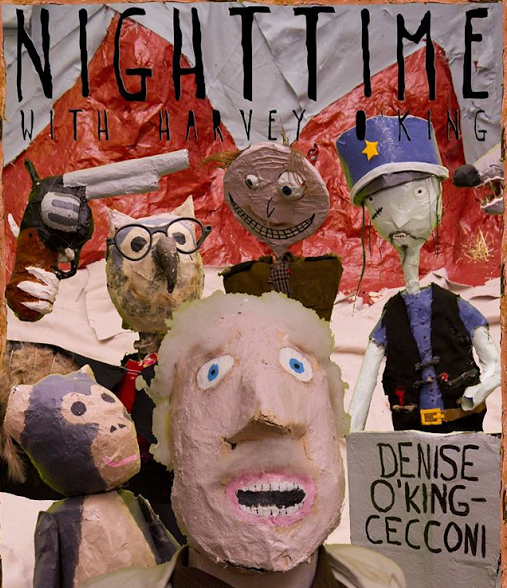
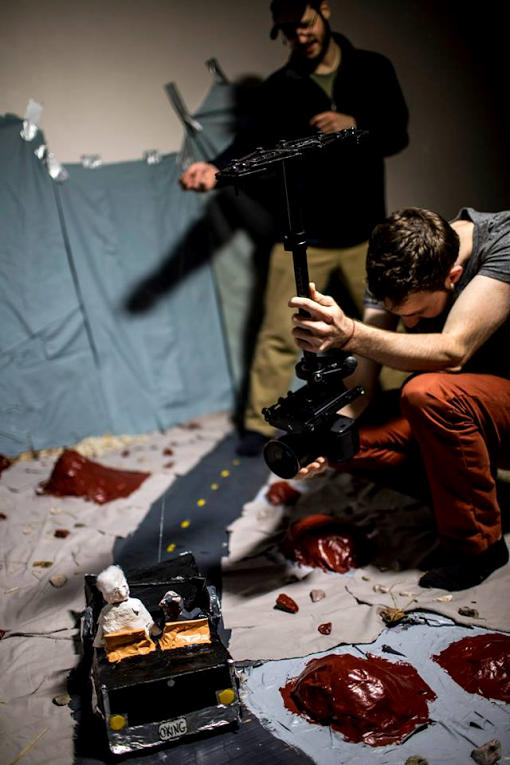
The characters are all puppets made of paper maché, and therefore each is frozen with one set expression. Harvey himself is stuck with a shocked look on his face, which humorously makes it appear that he is surprised by just about everything, even the things he says himself. His monkey is frozen in a perpetual smirk, which makes sense, as he very often fills the silence with a mad, maniacal cackle. “When I write characters for Night Time, I make them painfully obvious. Because I use models and not actors, the characters can never really change their facial expressions. So I try to write them as one-note-jokes,” Wisniewski says. “As for the voices and the look of the individual characters, I just try to do what seems natural and makes sense.”

The craft of the puppets and the show progressively get more artistic as the show goes on. The owl, which makes his first appearance in the second episode, and meets a gruesome fate in episode three, is one of the most well-crafted puppets on the show, with his feathers blowing in the wind as he insults Harvey with breezy nonchalance. When talking about making the puppets, Wisniewski says, “Basically I ball up paper into the shape of the thing I want to make, put paper mache over it, wait for it to dry, then paint it. Most of what you see in the show is taped cardboard or balled up paper.”

The series really takes off when Harvey and his monkey end up on the run and leave town, driving through the desert when they get pulled over by a rogue cop. The story just escalates from there, which I won’t spoil for you, but it takes some dark twists and turns that are not for the faint of heart.

The series takes a decent sized group of talented people to create. “We usually complete the filming of an episode in like 4 or 5 nights, spread out over a month or so,” Wisniewski says. “There’s been a lot of great people involved with the production process. Pat Depuy, Tom Etu, Adam Pressley, Courtney Denk and Steve Zaionz are all good friends of mine that have played a big part in producing the show. In fact, they ultimately are the ones that make the show. I just sort of tell them what to do then edit footage.”

Harvey O'King2
Photo Credit: Joshua Underscore

The show is a new take on the creative things we can do with some paper maché, some editing software, and a camera. The story may be an acquired taste for some, but the humor as well as the detailed puppets make you appreciate the artistry that goes into each episode. The show demonstrates how the internet, and YouTube in general, have changed art forever for less well-known artists and their creative projects. Fourteen years ago, YouTube was founded, and it would be years later before the concept of a “YouTuber” ever existed. But it’s not just the celebrities that we pay attention to on YouTube, it’s anyone with a loud enough voice or heightened creativity and a camera. And this is making creative expression through video much easier and more accessible.

Night Time with Harvey O’King features music from bands in Buffalo. “The music is all local bands that I know or kind of know. They let me use their music for free and I’m super grateful for that,” Wisniewski says. The show features bands such as Green Jelly, Barry Brothers, and Harmonica Lewinski.

When asked if he is working on any other projects, Wisniewski says, “I don’t currently have any other projects that I’m working on. I am writing a number of things though. Also Steve Zaionz had a funny idea for a sketch called Italian Bob Dylan that I’d love to work on next.”

When asked what to expect from Harvey O’King in the future, Wisniewski says, “Well, you can expect the end of a story about a talk show host and his sidekick monkey. They commit an accidental murder, break out of jail, and end up getting abducted and tortured by a rogue cop. That’s basically the premise. The Cop has some big, idiot scheme that hasn’t been revealed yet but it just has to play out. We’re working on the 7th episode right now.”

Intrigued? Appalled? Check out the series here to learn more about the saga of Harvey O’King and his sidekick monkey.

*Please note that StreetPoetz is no longer an active site and the founder, Cece Carson, is now a business coach. Please contact her if a reference is needed.*